
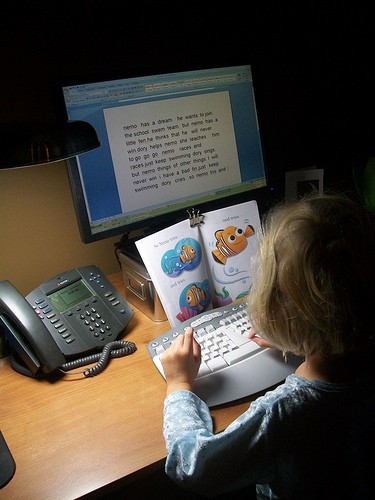
What is the value of typing?

What is the value of typing? This fall when our girls started kindergarten and first grade at the local elementary school they started using computers at school everyday. Our girls are generally fairly tech savvy. We play educational games on the iPhone and have bookmarks on the computer to SuperWhy? and The Electric Company set up for them.

This summer many of my teacher friends were up in arms this May when the National Association for the Education of Young Children (NAEYC) began updating its position statement on Technology and Young Children for the first time in 14 years. The CCFC pushed back, arguing that young children should have little or no exposure to screen technologies in child-care, preschool or kindergarten settings.

How important do you feel it is for your child to learn to be computer savvy? My girls asked for begged for me to set up books so that they could practice typing words. It definitely was useful for spelling, word recognition, and playing with punctuation. Yet, I still wonder if the time would have better spent writing with a pencil & paper.

What is your opinion on screen time for elementary aged school children?  Do you have any screen time rules or limits at your house?  Share your thoughts below or on Facebook or Pinterest.


PS: Don’t miss future posts and projects! Be sure to sign up for our RSS feed or connect online:

Related Posts Plugin for WordPress, Blogger...
  • Mdabols

    This is an interesting one for me….my oldest son has some difficulties that include coordination and visual-spatial perception, which translates into almost illegible handwriting as a 2nd grader. At his school he is allowed to type for certain subjects, namely journaling, because the physical effort it takes for him to write leaves no mental energy left for the language/composition part of the journaling. I get that, and I appreciate it. But as I parent I have had to push the OT at school to keep working on it with him. Additional wrinkle- I am an OT myself. They want him to go to keyboarding and, in my opinion, “give up” on the handwriting. I don’t get it. How can it be acceptable that a child has illegible writing? At age 6 or 7 is it reasonable to expect little gain? I don’t think so. Especially in a kid who has a lot of challenges and is still growing, and although slowly, is getting the pieces put together. Maybe I am not seeing the tech future for what it is- but I want my child to be able to write well.

    • http://www.facebook.com/gemmanerys Gemma Callahan

      My son, who has autism, is also being taught keyboarding in school. Not because they have given up on his handwriting, but because during writing class, they want him to focus on the content. In that particular scenario, “writing well” doesn’t mean the my son’s penmanship. But they do also want him to write legibly and his does have OT goals where he can work on his literal writing, as well.

      The brain is a “use it or lose it” organ. I see the school district’s point here in that they don’t want the child’s ability to compose writing and express himself to be compromised by his difficulty to form letters. These two things require very different skill sets.

      I know that with my son, his ability to compose text works just fine, but he gets bogged down with the mechanics of writing. So I wholeheartedly agree with his learning to touch type. The ability for my son to “write well” to me more about the content of what he is writing than how he writes it.

      But I see your point. At my son’s IEP last year, I actually asked the question, ” is there any research that shows a link between the ability to physically write and how it equates to actual writing skill?” and no one knew of any. I think that’s the big question…

    • Anonymous

      You both bring up an interesting point, the keyboard is great for letting ideas flow. Heck, even I feel my ideas can stream out faster with a keyboard. Gemma, your question is interesting, “is there any research that shows a link between the ability to physically write and how it equates to actual writing skill?” My personal guess would be, there is not. If you find additional info please share.

      Yet, I too would still push the OT. You may not “see our technical future for what it is” because your vision is blurred by mom goggles. You want your son to be independent in his ability to write legibly. Yes computers will be (already are) a dominant part of our lives, but the ability to physically write will be something no one can take away from him. Power to you for loving your son enough to push back for what you feel is right for him!

  • Jen

    Handwriting is so much more than just being able to print letters to form words. My 4th & 5th grade sons have beautiful handwriting and have learned to print well, so this year they are learning keyboarding one day a week. This is an extra just to learn the process, but we do all school work hand written. Although I took only one typing class and one computer course in college early 90′s and did not use a computer again until ’99, I have had no difficulty in using the computer. So naturally I don’t feel it a necessity for young children. Here is a look at my 2nd grade sons problems with writing:
    It appears that the difficulty for Jack (then in 1st grade) was in trying to learn too many concepts at one time. He had so much difficulty printing and spelling that he was struggling in every subject and resulting grades were a poor reflection of his actual comprehension of the subject. His teacher and I would attempt read and reread his answers,but often we would still need to ask him to tell us what it was he had written. He read well and was often able to solve situation problems ( I am sure there’s a term for this) more quickly than I could, so I did not have any testing done. However, the stress of trying to keep up with the class was hindering his emotional development. My once most outgoing happy child was changed in two years to a shy,tearful child with zero confidence. What I did was switch to homeschool this year.
    After six weeks, I was able to pinpoint his learning difficulties. As a result we dropped to just Literature, Spelling, Penmanship and Arithmetic. In Literature anything that needs to be written, he answers orally, and I write ~no writing on his part. Spelling is a phonics based curriculum that teaches the phonics rules. There is no list to study. He practices the rules and spells the words by the rule not by remembering the word. Spelling is done orally and with letters tiles. Penmanship is two separate lessons each day one learning cursive and the second copy work or printing the alphabet. Strange as it may sound practicing cursive has really helped his printing. He is now writing on the line and putting spaces between most words. We do journal once a week, but it is just one or two sentances and a picture.
    In just four weeks I have seen a huge improvement in not only his handwriting but, most importantly, his cheerfulness and confidence levels. Real smiles have returned and tears are very infrequent. I even see him itching to try new things (that his big brothers do) and actually try a few of them. My goal is six more weeks of this and then he starts writing his own answers and by the second half of the year we resume English, History and Science. However, the acuality of that remains to be seen. It has been a good thing for him & for the family as a whole to be able to let him learn at his own pace.

    As a personal preference (and this is my personal preference for my personal family, not a means for me to judge how any one else should do things.), I don’t feel that daily time in front of any screen is physically or mentally healthy for any of my little ones. Any computer program, no matter how educational does a lot of the work for them. Work that would develop their minds and work ethic better if they had to do it manually. Also having a computer voice do all the praising and encouraging feed back (even if accompanied by a persons face) is developing non personal relationships. I am not a fan of how it is taking over our lives.
    How it is used in our home? Well, we have used the computer as a resource for pictures, reports and information we just wondered about. I do much of my own work ( I am a church financial secretary) on the computer. Pictures are edited and stored on the computer. We skype and facebook with friends and relatives. we also listen to radio and watch sports and shows on the computer as $30 a month is to large a chunk of our entertainment budget to spend on cable. =) Some shopping is done online. None of our children have acces to the computer individually. There is much danger on the internet, so we keep it locked away the same way we do our medicines– Doses administered under parental supervision only. =)
    There’s our issues & how we are dealing with them. Hope there’s some ideas here that will be a help.

    • Anonymous

      Jen, thank you for sharing! Are all of your boys home schooled? Will Jack remain at home throughout the duration of his elementary years or will you send him back to the classroom eventually? We have a charter Montessori elementary school in our city. I know a lot of home school parents use it as a starting zone for their home school kids because there too the children learn at their own pace. Loved your explanation of the use of your computer too.

  • http://pulse.yahoo.com/_643SOJCW3QLDZ77XC4TADGWJ7I Michele

    Just want to toss in a few comments even though I have not read every else’s yet (so please forgive me in advance, thanks):

    I believe that learning to WRITE needs to happen before learning to type, just as learning to CRAWL needs to be done before learning to walk. Each step in a person’s development is essential, even if it is difficult to master. It has to do with how the brain/body work together. I’ve been told that if a child walks BEFORE they crawl, there is a “gap” that eventually needs to be closed because it can effect other things that they try to learn.
    An example: I know a fellow who was could NOT copy something from the chalkboard to paper if his life had depended on it! This is not to say that he couldn’t “read” what he had written, but that what he had written on the paper was NOT what was originally on the chalkboard–meaning that some connection between his eyes, brain, and hand was not there! (Please understand that this kid was really smart in a lot of ways–he read books by the dozens & could memorize/repeat anything & everything, and could beat the socks off of anyone who dared to play a video game against him!) but as for writing down something legibly and accurately onto a piece of paper–it had TOTALLY ESCAPED HIS GRASP. When I learned about his situation, he was already about 12 years old and had had the problem for years, but had been advanced annually along with his classmates. I honestly don’t know whether or not he has ever managed to close that gap in his development, but DO know that he has had a hard time moving forward in many areas of his life; he is now 30 years old.

    “Learning to write” can mean so many things, including: putting pencil to paper and getting your fingers/hand/arm, (as well as your eyes/brain) to coordinate in identifying and reproducing the letters of the alphabet individually as well as in groups (to form actual words); mastering the use of a crayon, pencil, pen, brush, etc. to put onto paper a word or an idea (and to accurately communicate those words or ideas to someone else).

    Please do not misunderstand me–I am not saying that your child needs to have “perfect” penmanship, but they DO NEED TO KNOW HOW to write: legibly, accurately, effectively. Keep in mind, that even in our high-tech world, there ARE times when you need to put words on paper–NOT everything can be done on a keyboard (yet).
    An example: My brother used to manage a video store, and said that some people were unable to fill out a simple job application–not only because they did not understand how to complete the requested information, but because they were UNABLE TO WRITE and/or spell!

    I, too, chose to home educate my children, and at times, also chose to “take dictation” (especially when we were working on subjects like creative writing–for me, it was more important to get their thoughts onto the paper than to be concerned about their ability to put them there). Other mothers had different ideas, however, and insisted that regardless of what subject the children were doing, proper penmanship was required. (One of the beauties of homeschooling is being able to do what is right for YOUR child!)

    I could go on about various aspects of this subject, but want to say that I truly believe that WRITING is becoming a “lost art” and that we have a responsibility to keep it from disappearing completely! I occasionally find things like recipes, lists, quotes, photo notations, etc. that were written by my mom. What she wrote on the paper is not as important to me as the fact that I have something that was hand-written by her. We ALL need to know how to write, and to write legibly. Someday when the power goes out, it is the hand-written and printed that will still be around! :-D

    Here are a few ideas: write love notes & reminders to your children; keep a journal/prayer list/etc.; provide opportunities for practical use (ask your children to write items on the grocery list or jot down a phone number, address, etc. for you; have them write a short letter to someone to brighten their day; have them keep a list of the books they have read, the amount of time they have spent watching t.v. or playing a game, etc.); have a good supply of writing implements, scrap paper, Post-It Notes, and nice stationary/note cards/envelopes available; write down things in long-hand that are normally in number form (time of day, date, etc.); make it FUN TO WRITE!

    • Anonymous

      Thanks for your comment Michele! Loved reading your ideas.